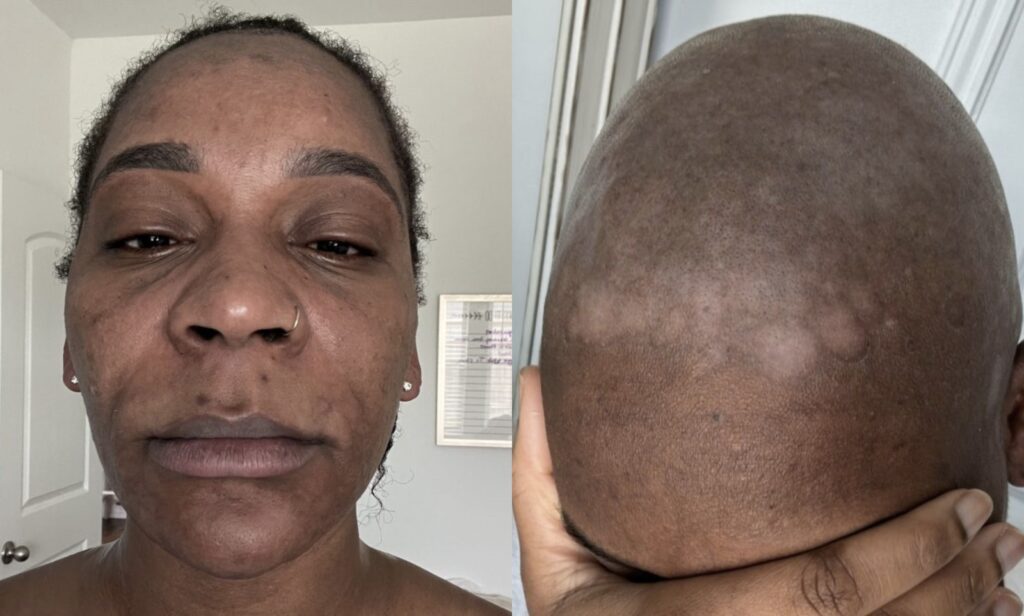
Kimberlee Mills, from Houston, has been diagnosed with Aquagenic Urticaria, a rare condition in which contact with water—regardless of its temperature—causes itchy, painful hives, redness, or swelling on the skin.
Follow the Elizabethblog channel on WhatsApp: https://whatsapp.com/channel/0029VbDQN5lI1rcbSgriLG2M
Because of the condition, Kimberlee said she has drastically changed her daily routine, including how often she washes her face and the way she stays hydrated.

Speaking about how the condition has transformed her daily life, she said:
“Aquagenic Urticaria affects almost every part of my life.
“My mornings look completely different from most people’s.
“Most days I rely on rinse-free cleansers and waterless skincare products.
“Before I leave the house, I check the weather.
“If it’s hot, humid or looks like it might rain, I have to think about whether it’s worth going out at all.
“Something as simple as sweating can leave me covered in hives.
“Most people don’t think about water.

“I have to think about it every single day.
“Everything has to be planned.
“I don’t shower every day like the average person.
“Even brushing my teeth requires planning to keep water exposure to a minimum.
“I don’t drink plain water because it makes me extremely nauseous, so I stay hydrated through other beverages and foods that I tolerate better.”
She also revealed that the reactions can sometimes become severe enough to require emergency medical attention.
“In severe situations I’ve experienced swelling and symptoms serious enough to require emergency medical treatment.
“The severity isn’t always predictable.”
Kimberlee explained that she first started experiencing symptoms when she was just 12 years old. For many years, doctors struggled to determine the cause of her reactions because the condition is so uncommon.
Initially, both she and medical professionals believed soaps, shampoos, or chemicals in the water were responsible.
However, after years of consultations with different specialists, she eventually underwent a water challenge test that confirmed she had Aquagenic Urticaria.

Recalling her long journey to receiving a diagnosis, she said:
“In the beginning everyone thought I was reacting to soap, shampoo or something in the water.
“Over time I realised it wasn’t the products, it was the water itself.
“After years of searching for answers and seeing multiple specialists, I finally underwent a water challenge test that confirmed I had Aquagenic Urticaria.
“The first thing I noticed was intense itching, burning and hives after showering.
“I also reacted after being caught in the rain and eventually realised I reacted to sweat too.
“It took more than a decade to finally get a diagnosis because the condition is so rare that most of the doctors I saw had never encountered it before.
“It was a very long and frustrating battle.

“I was relieved because I finally had an answer after so many years of wondering what was wrong with me.
“At the same time it was heartbreaking because I learned there wasn’t a cure.
“Having a diagnosis finally made me feel like I wasn’t crazy.
“It gave a name to something that had affected my life for years.”
Kimberlee said living with the rare disorder has affected not only her physical health but also her emotional well-being and family life.
She explained that activities many parents enjoy with their children have become difficult because sweating, rain, humidity, or even water rides can trigger painful reactions.
She shared:
“Living with Aquagenic Urticaria has affected both my mental health and my confidence in ways I never expected.
“It doesn’t just stop me from swimming; it impacts almost every aspect of my life.
“I can’t freely play outside with my children on hot days because sweating can trigger a reaction
“I have to think twice about taking them to water parks or theme parks because rides, splash zones, rain or even the heat and humidity can leave me in pain.
“Some of the memories parents dream about making with their children simply aren’t possible for me.
“Sometimes it feels like the world was designed around something my body can’t tolerate.

“It can also make me feel like a burden because my family has to help me with things many people take for granted.
“I’ve had to grieve the freedom I thought I’d have.
“The hardest part isn’t being allergic to water, it’s losing the freedom that comes with it.
“I can’t be spontaneous; I have to think about the weather, my surroundings, how long I’ll be outside and whether I’ll sweat.
“Water is something most people never think about but I have to think about it every single day.”
Kimberlee also spoke about the skepticism she has faced over the years, revealing that many people—including some medical professionals—found it difficult to believe that someone could be allergic to water.
She said:
“Most people think I’m joking.
“Once they realise I’m serious, they’re fascinated and have lots of questions.
“Others don’t believe me because it sounds impossible.
“That’s one of the reasons I share my journey online.
“As a child I constantly felt dismissed.
“Some people thought I was exaggerating my symptoms.
“Others assumed I simply didn’t want to bathe.
“As I got older, I still dealt with skepticism.
“There were doctors who laughed when I suggested I might be allergic to water or questioned the research I had done instead of listening to what I was experiencing.
“It was incredibly dehumanising.
“I knew something was wrong with my body and I was simply looking for answers.
“Receiving a diagnosis validated years of experiences that so many people had dismissed.”
Kimberlee said she now shares her story publicly to educate people about rare diseases and invisible illnesses, hoping her experience can help others receive earlier diagnoses and greater understanding.

She concluded:
“I want people to understand that it isn’t just about being allergic to water.
“It affects every part of my life and requires constant planning.
“I also hope people remember that just because a disease is rare doesn’t mean it isn’t real.
“My goal has never been to gain sympathy; it’s to raise awareness.

“If sharing my story helps someone receive a diagnosis sooner, encourages people to believe someone living with a rare disease or helps others understand invisible illnesses, then every vulnerable moment has been worth it.
“Water is something most people never have to think twice about.
“For me, it’s something I have to think about every single day.”