A man identified as David Neville Johnson has been banned from keeping animals for 16 years after being found guilty in what has been described as Britain’s largest exotic pet neglect case, involving over 2,000 animals.
The shocking case, known as Operation Herald, uncovered horrifying conditions in which 1,870 live creatures — including geckos, tortoises, snakes, parrots, and lizards — were rescued, while 31 animals were found dead.

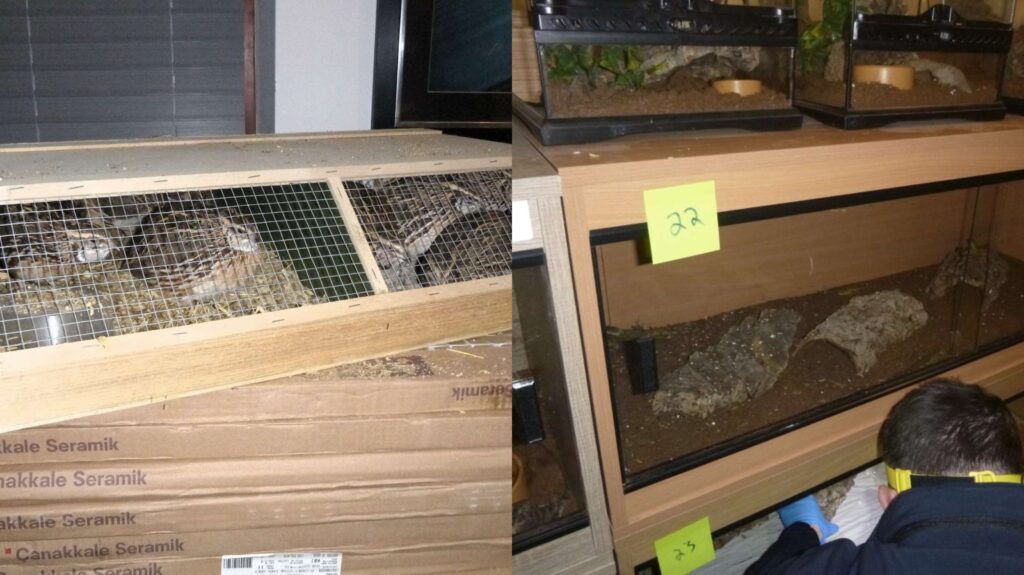
According to RSPCA Inspector Kate Parker, the animals were discovered at Cosford Grange Farm Shop, Holyhead Road, Albrighton, Shropshire, and at Senorita Sparkles in Newport, Shropshire, where 73 Hermann’s tortoises were found in distressing conditions.
During the investigation, authorities seized an enormous number of neglected exotic animals, including: 1,061 leopard geckos, 294 Sulcata tortoises, 18 reticulated pythons, 73 leopard tortoises, 22 rose belly lizards, 14 Chinese water dragons, 47 green basilisks, 10 smooth helmeted iguanas And many more
Tragically, 399 animals died due to Poor condition they were kept in.
At Shrewsbury Crown Court on September 25, Johnson pleaded guilty to nine offences under the Animal Welfare Act, ranging from failing to meet the needs of reptiles and quail to causing unnecessary suffering to Hermann’s tortoises, African grey parrots, and other animals.

The court sentenced him to 24 weeks in jail, suspended for 18 months, and ordered him to complete 125 hours of unpaid work alongside 20 rehabilitation activity days.
He was also banned from keeping any animals for 16 years and faces a Proceeds of Crime Act hearing scheduled for November 5.
Speaking about the case, RSPCA Inspector Kate Parker said: “I could instantly feel that it was cold inside.
“It was cold inside for any animal, let alone reptiles.
“I could see that from the many vivariums, tanks and tables there was not much movement, or immediately evident signs of life, from the animals inside.
“Many of the set ups had equipment, such as heat lamps, designed for the keeping of reptiles, however the plugs were not plugged in, or the switches were off.
“From my initial observations, I saw some skeletons, decayed animals in vivs, dead tortoises and also some upside down tortoises.
“I was surprised by the low temperatures. Equipment including bulbs, strip lights and UV lights were of standard type, however they were not turned on, and some plugs removed from sockets themselves.”
RSPCA Lead Exotics Officer Kim Greaves said: “This case was certainly one of the biggest exotics cases I’ve seen as an Inspector
“There were dead and dying animals and it was incredibly sad to see such beautiful animals in these conditions.
“These animals were then sold on to unsuspecting individuals and the pet trade, who probably had no clue they were being kept like this.
“This was a complex and distressing operation involving around 30 RSPCA officers – including six exotic officers – along with two vets who were exotic specialists.
“I was very proud of the exotic officers, and indeed all the Inspectorate as it was a gruelling day but everyone worked hard to achieve and secure the best outcome.
“A personal thank you to Phil Hamilton from the RSPCA’s veterinary team whose work on the day was invaluable helping to arrange places for the animals to go.”
Adding the RSPCA Chief Inspector William Mitchell said: “This was a massive operation for the RSPCA and I would like to thank the many rescue officers and Inspectors who worked tirelessly on rescuing these animals, as well as the vets and exotics specialists who took on these animals for boarding at short notice.
“Exotic animals have very specific needs… reptiles may look resilient but they are completely reliant on their owners to provide the correct environment, including heating, lighting and an appropriate diet. Without proper care they become ill or suffer and, in severe cases, die.
“We would like to thank West Mercia Police, National Wildlife Crime Unit, Telford and Wrekin Council and the private exotic vets for their support and expertise on this case.”
See below……..