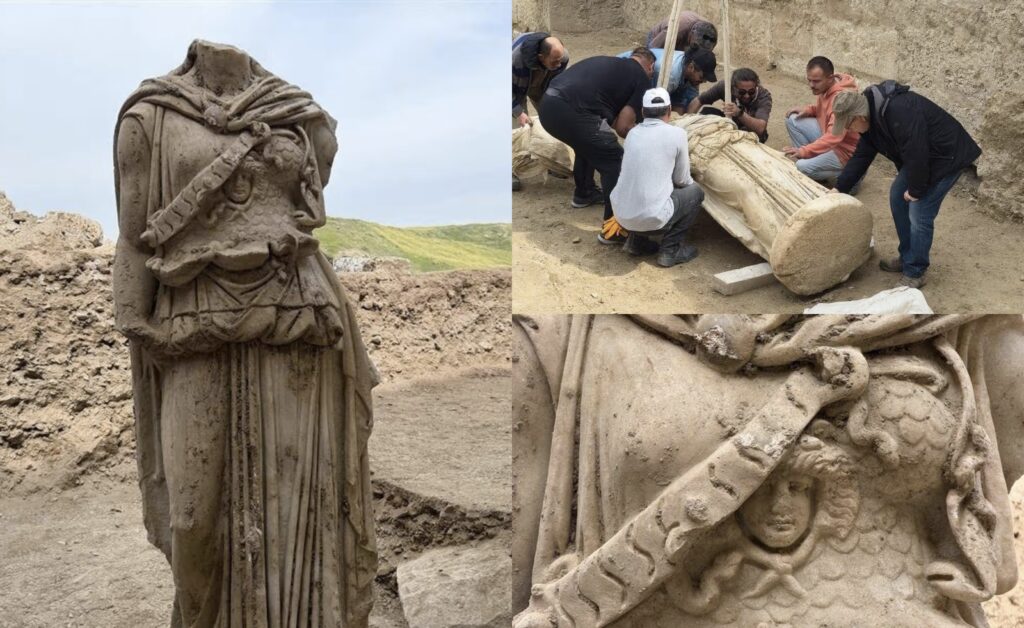
Archaeologists working in the ancient city of Laodicea in Turkey have uncovered a colossal 2-metre-tall white marble statue of the Greek goddess Athena at a site famously referenced in the Bible.
The remarkable discovery was made in the West Theatre section of the excavation site, where researchers found the statue lying face down among debris near the outer wall of the stage building in an area known as the postskene.

Although the head of the statue is still missing, the marble body remains largely intact and continues to impress archaeologists with its detailed craftsmanship and historical significance.
The newly uncovered Athena statue is decorated with an aegis across the chest, featuring the head of Medusa surrounded by intricately carved snakes. In Greek mythology, the aegis was closely associated with both Athena and Zeus and is often described in Homer’s Iliad as a protective shield or animal hide.

Experts noted that the sculptor intentionally left the back of the statue unfinished because it was designed to stand between architectural columns, meaning only the front would be visible to the public.
The front of the statue, however, contains elaborate details, including realistic fabric draping and finely crafted marble work that historians say are characteristic of the reign of Emperor Augustus, who ruled from 27 B.C. to 14 A.D.
The goddess is depicted standing on a circular base while wearing a sleeveless peplos and a cloak draped elegantly around her neck.
The West Theatre itself once contained 16 columns on each tier, with spaces between them serving as galleries for statues of gods and mythological scenes inspired by Homeric epics such as Odysseus.
The ancient city of Laodicea also carries major biblical significance. In the Book of Revelation, the Apostle John addressed the church in Laodicea, criticizing its people for being spiritually “lukewarm.”
One well-known passage from Revelation 3:17 states:
“You say, ‘I am rich; I have acquired wealth and do not need a thing.’ But you do not realize that you are wretched, pitiful, poor, blind and naked.”

Turkey’s Culture and Tourism Minister Mehmet Nuri Ersoy announced the discovery as part of the country’s “Heritage for the Future” archaeological project.
“In the stage building, we have brought to light the Athena statue, about 2 meters long, made of white marble,” Ersoy stated.
The Laodicea excavation site has continued to produce important discoveries from the Roman era in recent years. Earlier excavations in 2024 and 2025 reportedly uncovered figures depicting the sea monster Skylla and the cave of the giant Polyphemos.
Researchers also explained that Athena held special importance in Laodicea beyond her role as the Greek goddess of war. Historical inscriptions found at the site reveal she was also associated with weaving, which was one of the city’s main industries during ancient times.