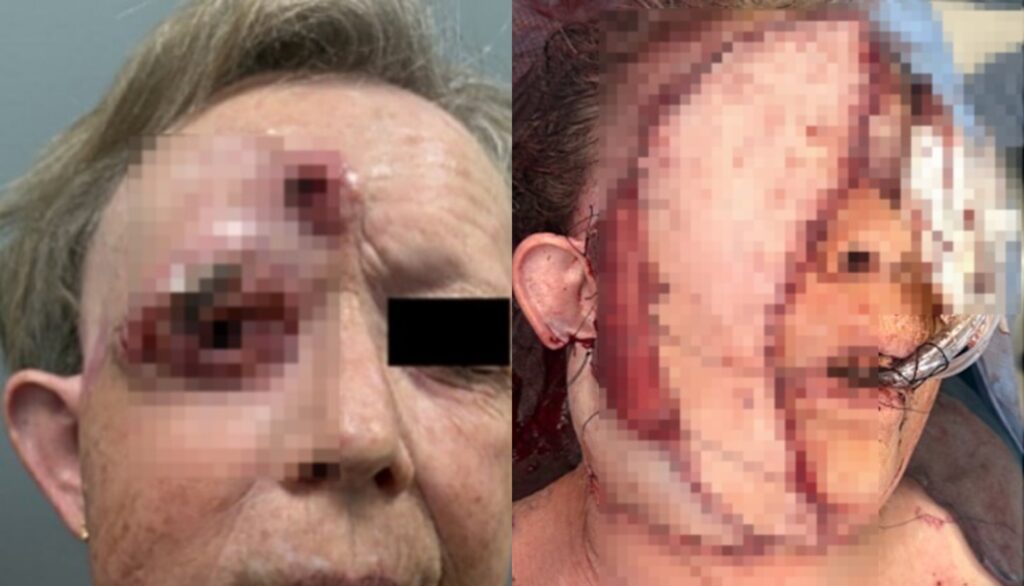
A 69-year-old woman has undergone extensive facial surgery after battling a rare and aggressive form of skin cancer that spread across some part portion of her face.
The patient, identified as Mrs. B, had been fighting the disease for four years before doctors resorted to the life-saving procedure as a final option. Prior to her cancer diagnosis, she had already undergone both liver and kidney transplants, making her condition even more complex to manage.

Medical reports revealed that she was diagnosed with recurrent porocarcinoma, a rare cancer originating from sweat glands. Her treatment journey began in 2021 after a tumour was discovered on the right side of her forehead, which was surgically removed.

However, during subsequent chemotherapy, doctors discovered that the cancer had already spread into nearby nerves and surrounding tissues. Scans also revealed abnormal growth in the parotid gland near her jaw.

She later underwent extensive surgery, including the removal of lymph nodes in her neck, complete removal of the affected gland, and facial reconstruction using skin grafts. Despite these efforts, pathology results showed that the cancer continued to spread through blood vessels and nerves.

In an effort to control the disease, she underwent a demanding course of radiotherapy, consisting of 33 sessions targeting the right side of her face and neck. Unfortunately, the cancer returned in 2023.
Surgeons carried out another operation, removing part of her frontal skull bone and performing additional skin grafting. A second cancerous growth later developed near the inner corner of her eye, requiring further surgery and another round of radiation.
By 2025, the disease had progressed aggressively, with multiple tumours spreading across her face. Doctors documented severe swelling, large ulcerated masses around the eye socket, and cancer spread to nearby lymph nodes.
At that stage, specialists determined that there were no conventional treatment options left. Further radiotherapy was ruled out due to safety limits, while chemotherapy was considered unlikely to be effective. Immunotherapy was also deemed too risky because of the high chances of organ rejection and failure linked to her transplant history.
As a final attempt to control the disease, surgeons performed a major operation removing large sections of the right side of her face, including the contents of the eye socket and affected tissues.
Following the procedure, doctors carried out complex reconstructive surgery using tissue from her abdomen, chest, and scalp, along with skin grafts to rebuild the affected area.

Medical experts note that porocarcinoma is an extremely rare and aggressive cancer, accounting for less than 0.01% of all skin cancer cases. It typically affects older adults and is known for its ability to spread quickly through the body’s lymphatic system and nerves.
Mrs. B’s case has been documented in a recent medical journal, highlighting both the challenges and complexities involved in treating such a rare condition.