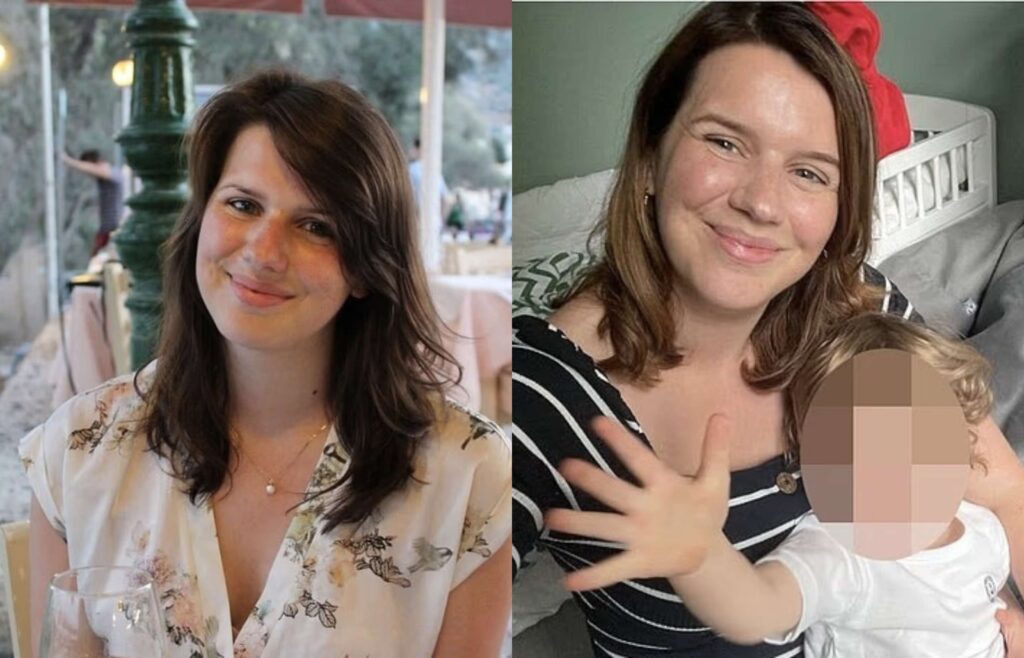
Greater Manchester, UK — A heartbreaking inquest has heard how Jennifer Cahill, a mother who opted for a home birth against medical advice, and her newborn daughter Agnes Lily, both died shortly after delivery in Prestwich, Greater Manchester.
Mrs. Cahill, an international export manager, had expressed her desire for a “completely physiological” birth — with no medication and minimal medical intervention. She had planned a calm, natural environment, illuminated only by tea lights, and requested that midwives speak softly and avoid physical examinations unless necessary.

During the inquest held in Rochdale, midwife Julie Turner — who assisted during the final stages of the birth — recalled the mother’s haunting final words as she struggled through labour.
“She was beating herself up because it wasn’t happening,” Ms. Turner said. “She was struggling and shouted, ‘I really want to do this. I am a warrior! Why will my body not let me?’”
Ms. Turner, who has been unable to work since the tragedy, described the atmosphere as “intense” as complications began to unfold.
According to reports, Jennifer had previously suffered a postpartum haemorrhage during the birth of her first child three years earlier. Because of that, doctors had advised her to deliver her second baby in hospital. However, feeling unsupported during her first experience, she instead chose a home birth.
During labour, Jennifer became exhausted as her contractions intensified. When her daughter was born, the umbilical cord was wrapped around the baby’s neck, and she was covered in meconium — a sign of fetal distress.
Both mother and baby were rushed to North Manchester General Hospital, but tragically, Agnes died three days later from hypoxia (a lack of oxygen), while Mrs. Cahill succumbed to haemorrhagic shock and multi-organ failure after losing an estimated two litres of blood.

Her husband told the inquest that no one had fully explained the risks associated with a home birth, adding that they believed the medical advice to deliver in hospital was primarily due to a previous Strep B infection during her first pregnancy.
A representative for Manchester University NHS Foundation Trust admitted that Mrs. Cahill should have been referred to a senior midwife to properly discuss the potential dangers of a home delivery, given her medical history.
The inquest also revealed that police have investigated an online home-birth support group after learning that Jennifer had been an active member.
Ms. Turner concluded by saying that an increasing number of mothers requesting home births has left many midwives deeply concerned about being called out to potentially unsafe situations.
She said: “There was unease in the office about high-risk births. Midwives were getting nervous about being on-call.
‘We seemed to to be getting more women with complex plans.
‘It used to be unusual for high-risk women to have a home birth, but in the last couple of years there has been a significant increase.
‘Staff were fearful. It is one of the reasons we now go out in twos so that we can support each other.’
The midwife explained that Mrs. Cahill had declined a Strep B test and initially refused any vaginal examinations.
She recalled that around 4 a.m., Mrs. Cahill appeared to be experiencing a normal labor. However, it was later discovered that the gas and air equipment wasn’t working because the bottle and tube were faulty, and they had to fetch replacements. Ms. Turner noted that it had been difficult to test the equipment beforehand since it was sealed in a sterile bag.
She also admitted that record-keeping during the birth was poor, with most of the data missing in the later stages of labor and some notes hastily written on scraps of paper. The last recorded blood pressure reading for Mrs. Cahill was high — something that should have been rechecked within 30 minutes, as it might have indicated distress in both mother and baby.
“I can’t say we didn’t take another blood pressure check, but I accept there’s no record of it,” Ms. Turner acknowledged.
The midwife became emotional as she described how baby Agnes Lily struggled to breathe after birth. When the oxygen mask failed, she resorted to giving mouth-to-mouth resuscitation in a desperate attempt to save the newborn.
A later investigation found that the resuscitation efforts did not meet national guidelines or standards.