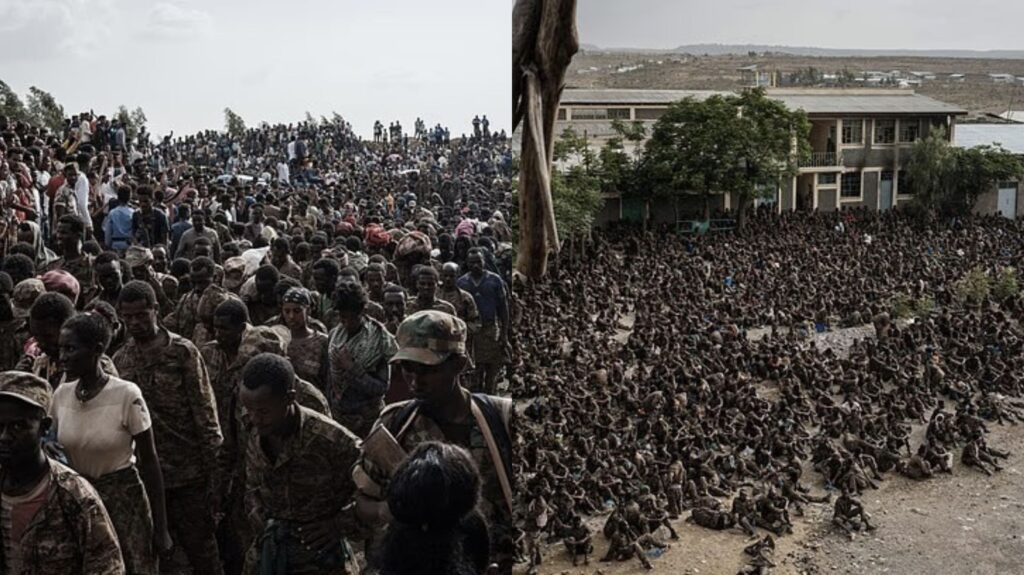
Survivors of the Tigray conflict in Ethiopia are beginning to speak out about the brutal violence that affected thousands of civilians. In a recent interview with French newspaper Le Monde, a woman named Tseday, a mother of two, shared her harrowing experience.
According to her account, she and her husband were living peacefully with their children in the Oromia region when their village came under attack.

She said: “They r*ped me first, then my two-year-old daughter. After that, they killed my husband and c**t up his b-dy in front of us. They forced us to watch”
Another victim named Nigist a 17year old also shared her experience saying: “They told us to undress, but I resisted.
“That’s when they started hitting me, tearing off my clothes. I was raped by several of them. Then I fainted.”
Author and expert Birhan Gebrekristos, speaking to Le Monde, revealed one of the most horrific acts committed during the Tigray conflict: Eritrean soldiers reportedly forced a pregnant woman into a miscarriage by st-bbing n-edles into her w-mb. Tragically, her baby did not survive, and she later died from a severe infection caused by the attack.
This heartbreaking story is just one of many from a conflict that saw unimaginable violence. It’s estimated that nearly 120,000 women were victims of sexual violence—roughly one in every ten women in the region.
The Tigray conflict began in 2020, following a dispute between the Tigray regional government and Ethiopia’s federal government over the postponement of national elections. In November that year, Ethiopian Prime Minister Abiy Ahmed launched a military operation in the Tigray region, accusing the Tigray People’s Liberation Front (TPLF) of attacking federal army bases. The TPLF denied these allegations.
As the war escalated, access for journalists was blocked, making it difficult to independently verify what was happening. Still, by February 2021, human rights organizations like Amnesty International reported mass killings. In one instance, Eritrean troops were accused of killing hundreds of civilians in the city of Axum.
Allegations of widespread atrocities continued to surface. Eritrean soldiers were accused of systematic rape and even holding women as sex slaves. In April 2021, a regional official claimed that some women were being kept in captivity by soldiers—a charge Eritrea strongly denied.
The U.S. government later described the violence in Western Tigray as “ethnic cleansing.”